Installing QtDraw#
QtDraw can be installed from PyPI using pip on Python 3.11 or later.
Requirements#
Python ≥ 3.11
[Optional] A MultiPie is recommended for using crystallographic symmetry operations.
Installation#
Set up a Python environment
macOS
Install Homebrew (if not already installed):
Install Python:
brew install python@3.13
Add Python (and LaTeX, if needed) to your
.bashrcor.zshrc:export PATH=/opt/homebrew/opt/python@3.13/libexec/bin:$PATH
If you use a virtual environment (e.g.
~/.venv), prepend its bin directory to PATH.Restart your shell.
Linux
Install Python using your distribution’s package manager or from source.
Add Python (and LaTeX, if needed) to your shell configuration file (e.g.
.bashrcor.zshrc):export PATH=/path/to/python/bin:$PATH
If you use a virtual environment, ensure its bin directory appears before the global Python path.
Restart your shell.
Windows
Install PowerShell and Python by following the instructions at: https://microsoft.com/PowerShell
Ensure that Python is added to your system PATH during installation.
Install QtDraw
All required dependencies will be installed automatically. In order to use MathJax rendering for LaTeX, install playwright browser such as chromium.
pip install qtdraw
playwright install chromium  # for Linux use `playwright install-deps chromium` instead.
Install MultiPie
Install the symmetry operation tool MultiPie:
pip install multipie
Linux (Ubuntu 22.04.4 LTS on WSL2)
Add the following line to your
.bashrc:export QT_QPA_PLATFORM=xcb
Install required system libraries:
sudo apt update
sudo apt upgrade  # optional, but recommended
sudo apt install libxcb-cursor0
Associate QtDraw file (.qtdw) to the application
It is useful to associate with the following application with
.qtdw,.cif,.vesta, and.xsfextensions.
MacOS
Download and extract QtDraw_MacApp.zip, and move it into Applications folder
Associate extensions with
QtDraw.app(Note)
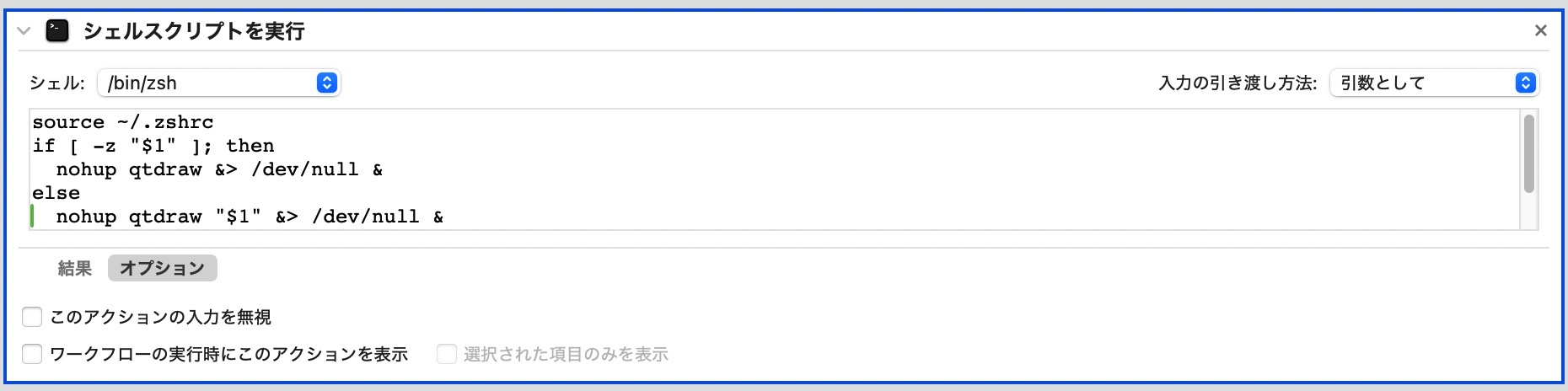
QtDraw.appis created by Automator with the following script:source ~/.zshrc if [ -z "$1" ]; then nohup qtdraw &> /dev/null & else nohup qtdraw "$1" &> /dev/null &
Windows
Associate extensions with
qtdraw.exeinScriptsfolder or QtDraw_WinApp.zipScriptsis found usually underC:\Users\<username>\AppData\Local\Programs\Python\Python<version>\
Shell Commands#
QtDraw provides the following command-line utilities:
qtdraw [filename]: Open QtDraw file.conv_qtdraw3 [ver1_file.qtdw]: Convert Version 1.qtdwfile into this version (Version 3).
See the Getting Started guide for examples.
Source Code#
GitHub: CMT-MU/QtDraw